The area had four main incoming lines from CAR, TC-BH 51 and 53 carried BBC 1 to us and TC-BH 52 and 54 carried BBC 2. We forwarded those to Crystal Palace, Birmingham, Bristol and Southampton and also later to Norwich (which previously was fed via Birmingham). On the desk we could switch between main and reserve lines or opt out any of those network feeds to allow transfers of material or pass on live interviews during times when the network feed was not needed. Such as regional programming or during trade test transmissions.
We had many incoming and outgoing local ends to BT Tower as we also had to the foreign bureaux such as NBC, ABC (Australia), CBC and so on. We had lines to ITN in Wells Street and from the Greenwood Theatre, Swains Lane OB and CP (Crystal Palace) OB receive points as well as London Airport (Heathrow). News receivers at Millbank, Barbican and CP as well as the incoming lines from Pebble Mill (x3), Bristol and Southampton plus lines in both directions to TVC, both CAR and SCAR (The Central Apparatus Room in the Spur, an extension to Television Centre). There were also the feeds around LBH itself and the Portland Place studio on the LG floor, which was still manned at the time.
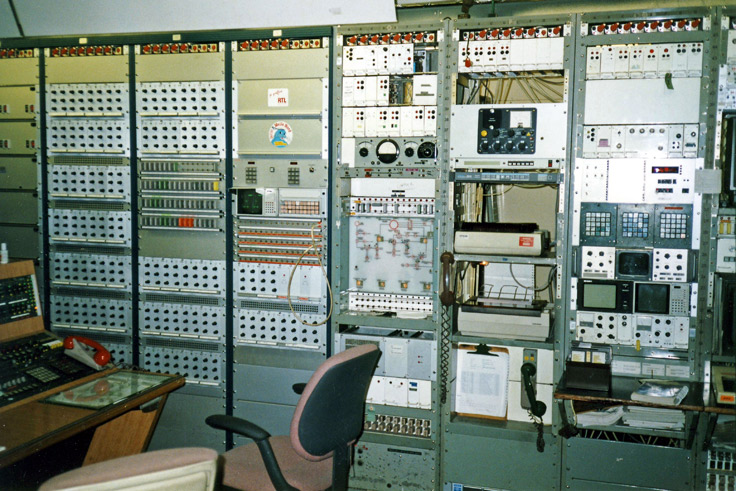
Equalisation and LOCO control
One of the interesting historical features was the LOCO (London Coaxial Network) that had an unequalised and unamplified cable extending via relays all around central London and as far out as Lime Grove. The pairs that provided the associated control lines also did the switching of those relays. A usual Sunday test was carried out on all the various permutations of switching with DC testing of everything to flag up any issues. Often programmes from the Proms or Boxing at the Royal Albert Hall used it, as did many ceremonial events around Buckingham Palace or Westminster. News used it heavily.
The main matrix had been a 25 x 25 one, a Designs Department build from the 70s with the source cards and destination cards at 90° to each other. They were triggered from the desk via relays that also drove the mono audio and the revertive lights on the panels. The audio feeds went via London Control Room upstairs.
Mono SiS (Sound-in-Syncs) took over from the audio lines, followed in the late 80s by stereo SiS, which took a while to bed in and required a switch from 676 to 728kb/s bit rate. We could reverse lines to some places, even out as far as CP or SWL (Swains Lane) and the local ends. Carrier circuits were derived 10MHz above the baseband video, although if noise was put down them from receivers it crosstalked onto BBC 1 or 2 distribution. As could 100% colour bars.
Most of the time we were equalising and testing lines before offering them through, all satellite bookings came via LO SWC back then from BT to be offered on to ICR (International Control Room) or News. We also had the incoming and outgoing EBU feeds for London via Permanent Network Vision links (PNV) or the satellite version.
On the desk as well as the waveform monitor, we had the matrix control, the Network switching, an EMX with 4 different coloured handsets dotted about, the DEL (Direct Exchange Line, ie not through the BBC telephone exchange), mono audio PPMs, 4-wire quawks to CAR, SCAR, LCR and the door intercom. Control lines to BT Tower NSC (Network Switching Centre), switching to reverse circuits, a teletext unit, and a later addition was the 64 x 64 Probel matrix, which as it could be remotely controlled, ultimately lead to the area losing the staff in early 1990.
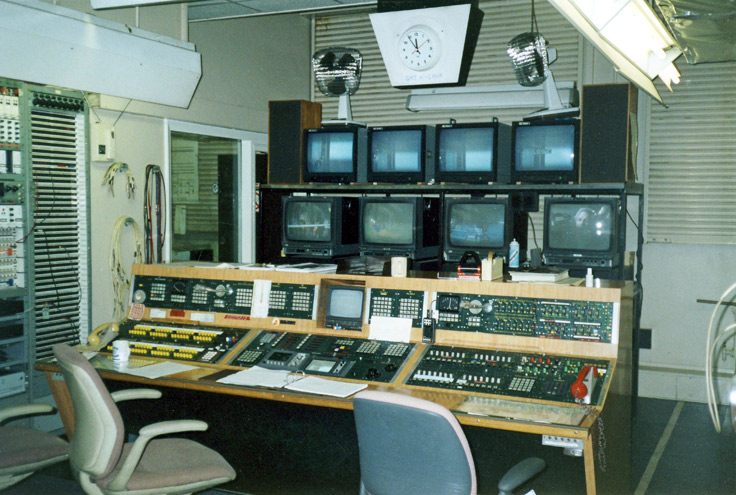
Centre desk and monitor stack
To keep an eye on all this we had 4 colour Barco monitors (BBC 1 and 2 off air were always on two of them, and often ITV and Channel 4 on the others unless we were busy). The top 4 Melford monochrome ones usually had BM-LO C1, C2 and C3 and BS on them if there was nothing else going on. Audio monitoring was a pair of Spendor speakers.
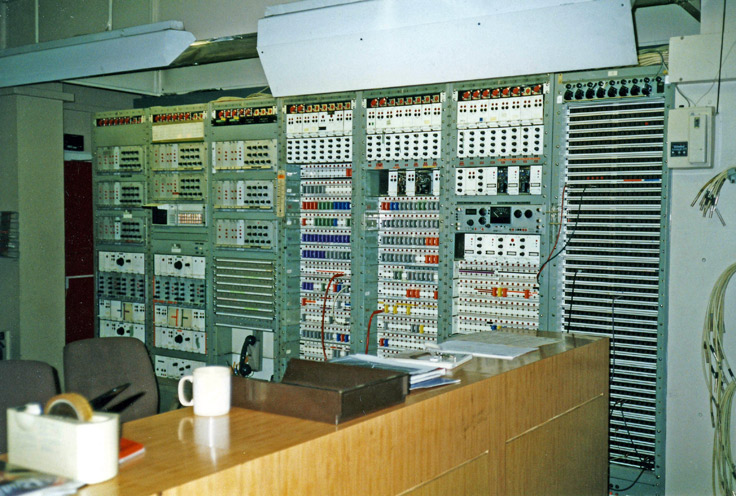
Jackfields
All the equipment was in the apps room off to the left of the control area. Bookings came in from Circuit Allocations Unit off the teleprinter on the Message Switching System, after they went home, we did the vision circuit bookings.
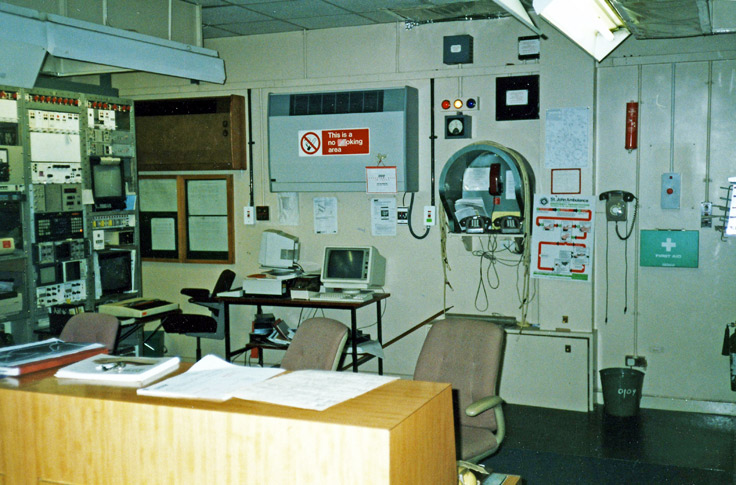
The rear wall
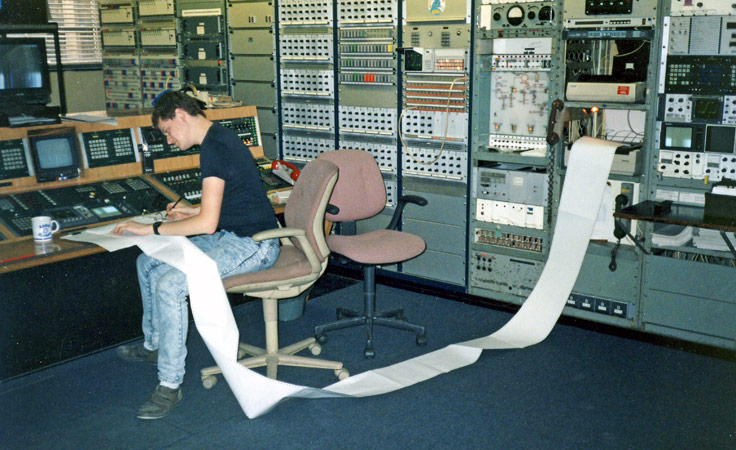
Printer problem
The photo shows me when we had accidentally switched the printer off and didn't spot we'd done so until we suddenly had lots of bookings which we had missed - when the printer was back on line it spewed out a roll of paper for me to write into the quarter hour booking sheets we used.
Saturdays for Grandstand, Children in Need and Elections were very busy times in there, but it was a very interesting area for a young engineer to be working in.
Amazing now that we only had access to one line from Carlisle to Manchester back then which had to carry not only feeds from the small TV position in Radio Cumbria's portacabin in the car park, but also everything from Glasgow, Newcastle and Belfast, plus it was in use for the North West opt out transmissions, somehow us and our Manchester colleagues in their CTA managed to co-ordinate the expectations from London. We could, of course, make use of BT Vision Protection Circuits - charged per minute at very high cost. We had to keep a close eye on their use to save money. However, nights such as the Lockerbie crash meant that all the world's broadcasters were trying to get their hands on those limited resources.
Staffing was 2 Supervisors a day who covered from 05:30 to around lunchtime and the late shift lunchtime until either both networks closed down or there was only one network on air with a film until closedown. We did not stay for Open University or the scrambled BBC Direct feeds. Us engineers rotated through a 10am - 10pm shift. Total staffing 5 supervisors and 3 engineers, of which I was one at the end.
One lunchtime that sticks in the memory, I was in LO SWC by myself as the supervisor was at lunch (for some reason the handover between early and late shifts was very brief) and the One o'Clock news had started. I suddenly had Manchester, Glasgow and several others all calling at once, which is never a good sign. Mike Walker in MR CTA said - we've lost both BBC 1 and BBC 2 into us! Panic, I offered Network 1 down the reverse contribution to BM, which normally was passed on to MR. I'm not getting that London…… Oh (expletive deleted!).
Just then the supervisor returned, as the DEL rang. It was the Pebble Mill Comms Centre on the line. They'd had a major power issue - a bus bar between the main and reserve changeover system to their power distribution had burnt out and they were in darkness. They had called BM Network Switching Centre at BT and got Pebble Mill taken out of the distribution to allow the north to carry on, but their local transmitters were now on the ropey RBL from Oxford, which was never great due to Oxford's lower power. That was sorted fairly quickly but that call didn't half make me jump. I only discovered decades later it was Mike in MR when we worked together in Tel OBs and we were chatting over a pint...
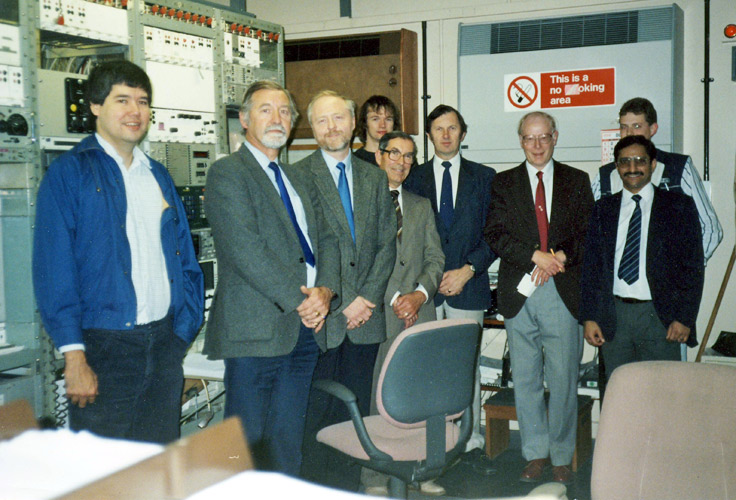
Staff group
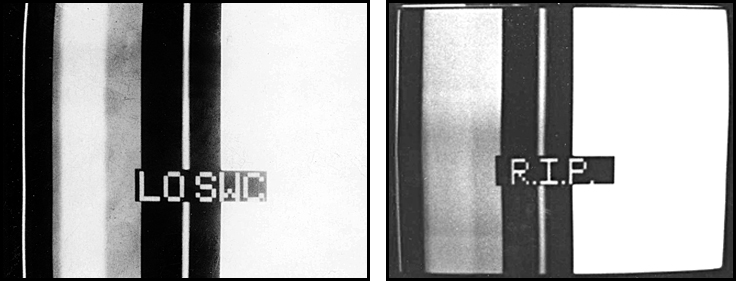
Our pulse and bar test signal had the letters made by diodes on a PCB. When we were closing, I built a second board which spelt out R.I.P. and it toggled between them slowly. We did have time to do that sort of thing back then, especially when the remote control was becoming used and we were just there to babysit everything. I ended up acting supervisor at various times, as did the other engineers. I was only 22 at the time.