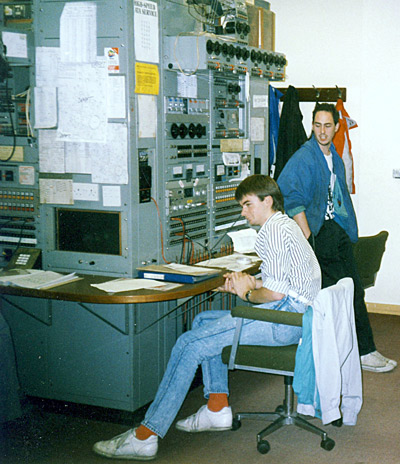
ATA audio end
There were five audio test bays, three of which were equipped for stereo testing with additional phase and delay equalisers to hand.
We had a full set of masks for EV3, EV5 and EV12 mono equalisers, as well as the less common EV9, bump killers and dip fillers. D2 and D3 phase delays and eqs. Regular OBs will be familiar to all who worked in LCR: the Radio One Roadshow, Any Questions, Choral Evensong, Friday Night is Music Night, and so on.
We also looked after the permanent lines from the regions and all the south east local radio stations, venues such as the Wigmore Hall, All Saints Church, the Royal Albert Hall, Westminster Central Hall and many football or other sports venues.
There were control lines (shared with Control Room and Switching Centre) to the regions, OB Comms office at Kendal Avenue, BT Trunks (Faraday) and Tower, LCR, CAR and SCAR and 5 DELs into us.
Temperature Correction Units were under our control, we had the temperature data from below ground sent to us each week from places around the UK which I then had to issue to the engineers to strap the TCUs differently as the winter gave way to spring, then summer back to autumn and winter. Line squeaks on bog rolls was also down to me. Monday morning fun.
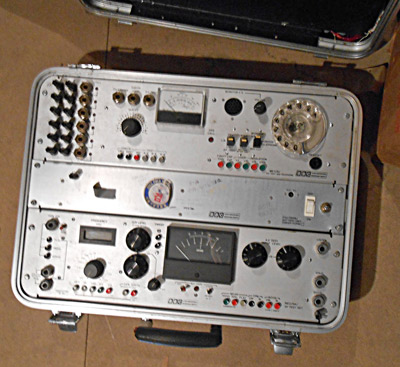
Lines test set
OB Lines Tests were generally carried out by the OB Comms Staff in the regions, Kendal Ave (for London), Birmingham, Bristol, Cardiff, Belfast, Glasgow or Manchester, although very local tests we occasionally did ourselves. ATA tested the permanent circuits. The test set with a full set of D sized batteries in them were portable as long as you were fit and healthy and into bodybuilding.
Line faults were dealt with by us, as were new provisions. Also, we installed and looked after feeds of the World Service or Arabic or African services to the various Embassies and Prince's Residences. Once BT had installed the music line we had to test it with Bush House CR and do some basic equalisation, then install a powered loudspeaker for the customer. Although those in charge listened to the BBC, I don't think the staff did. That often lead to last minute checks before "the Prince he come and the loudspeaker she no works" phone calls made in sheer panic. These installations were always generating stories when something unexpected happened, which was quite often. BT clipping a cable up the leg of a grand piano being one.
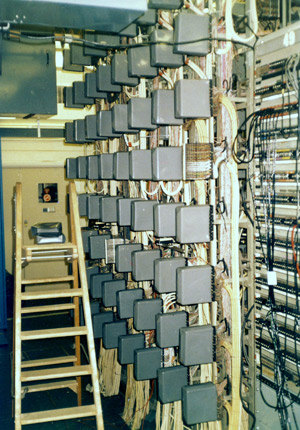
Part of the ATA frame
Once it was on air although we were supposed to stay for the first half of a concert, slipping out for a local pint was often done. We did both have pagers so were never far away.
On the data side - fault contact BH 2222 - we had the interregional lines which switched between PBX and then control or 4 wires out of office hours - usually 12 to each major region, plus smaller numbers to Kendal Avenue, Kingswood Warren, Wood Norton, local radio stations and similar places the BBC had. New York was another that could be a "music" style line for voice reports such as Letter from America. We had the incoming news agencies on telegraph feeds 80-0-80 volts on one wire - painful if it went up your arm while working on the frame, the distribution of those everywhere including all the lines to and from the Message Switching System (previously it had been the Automatic Data Exchange until that failed in November 1985 - my first day in ATA - a co-incidence, honest).
We had a megamux to TVC which I think was 2Mb/s, compared to the kilostreams at 19.2kb/s that was really fast, even more so than telegraph's stately 50 Baud speeds.
YZAR
This was the GPO / BT designation for the local
exchange in Broadcasting House - it may well still be! Y gave it the designation
for Radio sites, hence BT Tower YTOW, YZSK for Skelton and so forth. I
did wonder if "Zoo Along Road" was what it stood for, but I suspect something
far more boring is the answer!
Teleprinters and Telex were giving way to circuits over modems, we installed via our Duchess Street projects teams Statistical Multiplexors and Lion Limited Distance Modems to pass the feeds around buildings, often using the same cables that fed the internal telephone extensions.
We also had all the cable records for every circuit rented in the London area, the details of the line plant used (pounds per mile and loading applied as well as which cables between the exchanges were used) handy if BT had lost theirs. A cable fault would happen and straight away we would know which of our circuits were likely to be affected. The day BT Tower had a fire and lost power one lunchtime was one such day. We didn't lose any transmissions I think.
The day the London SE to Sydenham No 1 cable was cut twice rendering Crystal Palace with very limited BT connectivity was fun. It also affected the IBA's Beulah Hill site at Croydon. GLR, Capital, LBC and many other issues happened as the air rushed out the lead cable and the water rushed it, making the paper insulators conduct well. The repair did not go well. Mis-splicing gave us a right old mix of radio stations, telegraph, phone lines and phantom voltages all over the shop. Radio Links were pushed into service to keep BBC 1 and 2 and GLR on the air for a couple of weeks.
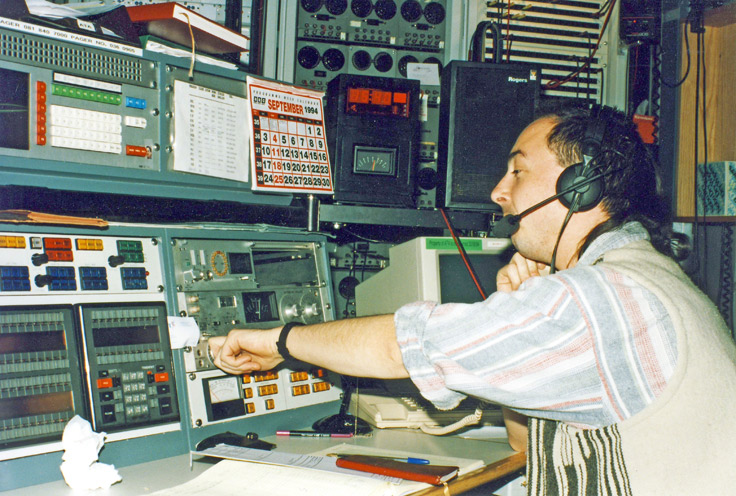
Mark Rivers in Audio Eq area of LCR, September 1994
